
21 Apr 2026
Transport Singapore 2026: Government Support Explained
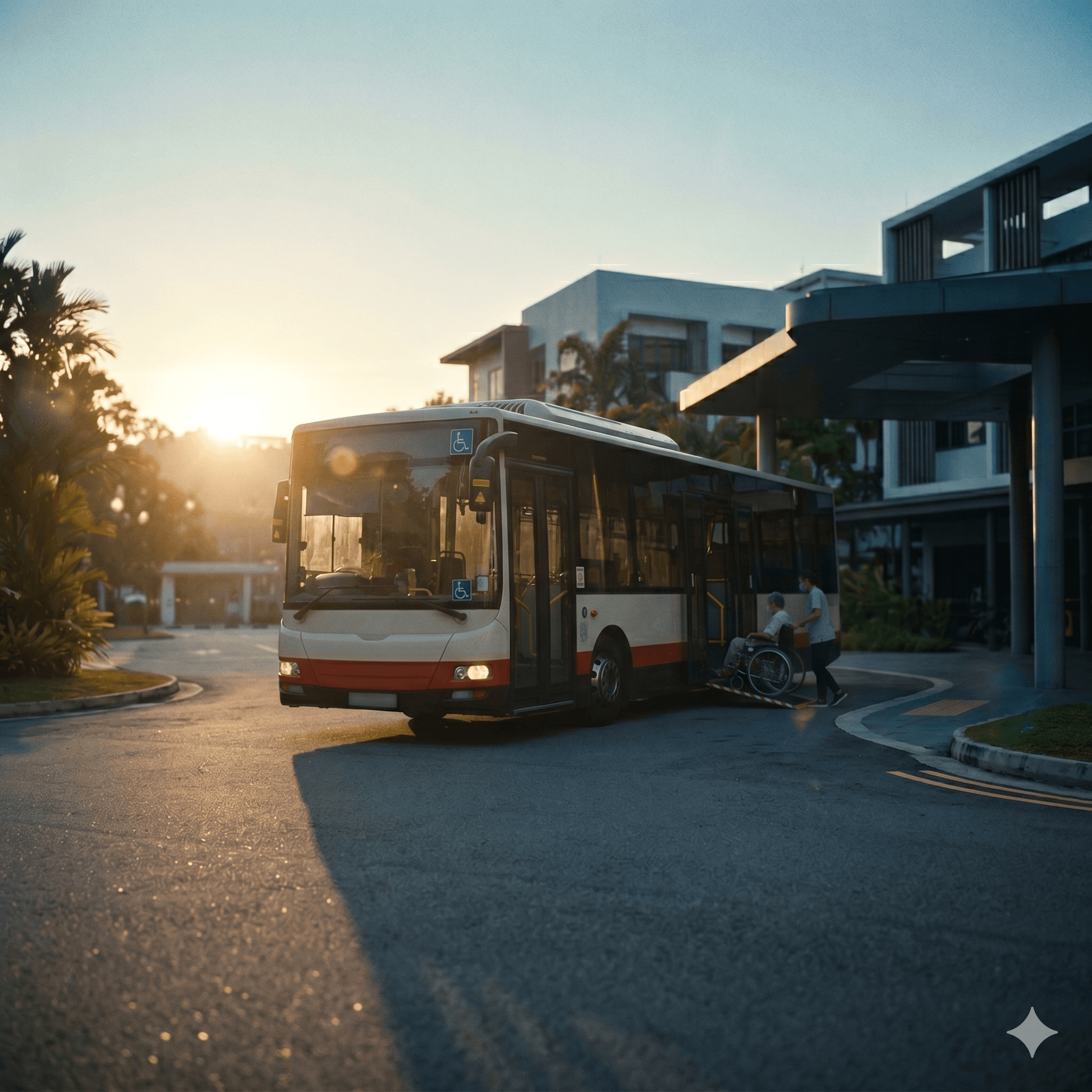
Every weekday morning, a quiet routine plays out across Singapore's residential heartlands. A bus pulls up outside a block in Tampines. A caregiver wheels her adult son down the ramp and onto the vehicle, bound for a Day Activity Centre in Bedok. The same bus will return him in the afternoon. It is a service the family depends on completely — and like most disability transport in Singapore, it runs on a thin margin that has become considerably thinner in 2026.
Rising fuel costs, driven by the escalation of the Middle East conflict from late February, have placed sustained pressure on ground transport operators across the island. For operators serving schools, persons with disabilities, and elderly patients at care facilities, the pressure is acute: these are services that cannot simply be reduced or deferred, and the families they serve are often among those least able to absorb a sudden fare increase.
In April 2026, three Singapore ministries — the Ministry of Education (MOE), Ministry of Social and Family Development (MSF), and Ministry of Health (MOH) — announced a coordinated package of temporary support measures to keep these services running without disruption.
The Three-Ministry Support Package
The headline measure is a government subsidy equivalent to 13% of transport fare revenues, applicable for services rendered in April, May, and June 2026. The support covers a wide range of government-contracted and subsidised transport providers: school bus operators serving primary and special education (SPED) schools, disability day services such as Day Activity Centres and Sheltered Workshops, and long-term care services including Senior Care Centres, Medical Escort and Transport operators, Day Hospices, and Community Dialysis centres.
The intent is straightforward: operators who would otherwise need to raise fares immediately, or reduce services, are given breathing room to continue operating while the fuel situation is monitored. In return, operators receiving the support are expected to keep fares stable during the April-to-June period.
The joint nature of the announcement matters. Disability transport Singapore 2026 is not a single sector — it spans education, social services, and healthcare, each with its own funding structures and regulatory frameworks. Coordinating support across MOE, MSF, and MOH signals that the government recognises the interconnected nature of the problem and is responding at the appropriate level.
School Bus Support: Primary and SPED Schools
For families with children on school bus services, the 13% fare revenue support applies to operators serving primary schools and SPED schools. Operators are required to maintain services without disruption during the support period.
Students on the MOE Financial Assistance Scheme (FAS) continue to receive the most direct protection. Since January 2026, MOE FAS students receive school bus subsidies covering 70% of their monthly school bus fares — up from 65% previously. For families who qualify, this means the majority of their transport cost is already absorbed.
The qualifying criteria for MOE FAS are a monthly gross household income not exceeding $4,000, or a per capita income of $1,000 or below. Families who need additional support, or who do not meet the FAS thresholds but are still struggling with transport costs, are encouraged to approach their child's school directly for school-based assistance.
For SPED students, the route to support runs through the Enabling Transport Subsidy (ETS), administered by SG Enable. The ETS provides tiered subsidies based on citizenship and per capita monthly household income. Singapore Citizens with a household per capita income of $3,600 or below are eligible; Singapore Permanent Residents qualify at $2,600 or below. For households with no income, the annual value of the residence as reflected on the NRIC should be $21,000 and below.
SPED students whose families do not qualify for the ETS may approach their school for additional support.
Disability Day Services: Day Activity Centres and Sheltered Workshops
For adults with disabilities who attend Day Activity Centres (DACs) or Sheltered Workshops, the support flows through a different channel. MSF will provide the 13% fare revenue support to Social Service Agencies (SSAs) currently running MSF-funded disability services and using the ETS for client transport arrangements. These SSAs are then required to pass the grant through to their contracted transport operators.
In practical terms, families using disability day services transport should not see fare increases during April to June 2026. The funding chain — MSF to SSA to operator — is designed to ensure the client-facing fare remains stable while the operator is still compensated for higher fuel costs.
SG Enable will be contacting all affected SSAs directly with operational details on how the support is structured and disbursed.
Beyond the immediate support period, the ETS is due to be enhanced from July 2026. The enhancement will increase subsidy rates and expand coverage to households with a per capita monthly income of up to $4,800 — up from $3,600 for Singapore Citizens currently. This is a meaningful widening of the eligibility net, and families who previously fell just outside the qualifying threshold should check their eligibility from July onwards.
Long-Term Care and Community Dialysis Transport
MOH's component of the support package covers Senior Care Centres, Medical Escort and Transport operators, Day Hospices, and Community Dialysis centres. These services transport Singapore's elderly and chronically ill patients on a regular basis — often multiple times a week.
The 13% fare revenue support applies for services rendered from April to June 2026. MOH and the Agency for Integrated Care (AIC) will provide further operational details to service providers by end-April 2026.
The longer-term picture is also more positive for this group. As announced at Budget 2025, subsidies for long-term care services — which include transport — will be enhanced from July 2026. Elderly patients and their families can expect a more detailed update from their service providers as July approaches.
For families coordinating transport for a parent or elderly relative receiving dialysis or day care in areas such as Toa Payoh, Bishan, or Jurong, the message for now is that fares should remain stable through June, and that enhanced subsidy support is coming in the second half of the year.
What Happens After June 2026
The support measures are explicitly temporary. Both the government's statements and the structure of the funding make clear that the 13% subsidy is a bridge, not a permanent fixture. Acting Transport Minister Jeffrey Siow acknowledged in Parliament that if fuel prices remain elevated beyond the support period, fares may still need to rise.
What this means for families planning their transport arrangements is that the post-June period carries more uncertainty than the current quarter. Operators who have held fares stable during April to June — at the government's request — may seek adjustments from July if cost conditions have not eased.
For regular, recurring transport needs — a child attending SPED school five days a week, an elderly parent commuting to a Senior Care Centre, an adult with disabilities travelling to a Day Activity Centre — this uncertainty is worth factoring into planning now. Families who have options for how they arrange certain journeys should consider reviewing those arrangements before July, rather than waiting until a fare increase is confirmed.
Transport Beyond Subsidised Routes
Government-subsidised transport covers the regular, recurring routes that fall within MOE, MSF, and MOH-funded frameworks. It does not cover every transport need a family with school-going children, elderly relatives, or members with disabilities might encounter.
For journeys that fall outside subsidised routes — family airport transfers, group outings for individuals with disabilities, medical appointments requiring a vehicle with luggage capacity, or milestone events such as graduations and family dinners — scheduled private transport offers a different kind of reliability.
Board operates scheduled transport across Singapore, with pricing confirmed at the time of booking. Vehicles range from Premium Sedans and MPVs accommodating up to six passengers, through to Medium and Large Buses for group journeys of up to 45 passengers. For families or community groups coordinating transport for persons with accessibility requirements, knowing the vehicle, the price, and the pickup time in advance removes one source of uncertainty from a day that may already have many moving parts.
Booking Transport with Board
For journeys that sit outside the subsidised frameworks described in this article, visit board.sg to get a quote. Bookings are recommended at least 72 hours in advance to ensure vehicle and driver availability. For recurring group arrangements or multi-stop itineraries, contact hello@board.sg to discuss options.
Scheduled transport is not a replacement for the subsidised services that disability and long-term care transport providers deliver — those services do essential work that private operators do not replicate. But for the journeys that sit outside those frameworks, knowing your arrangements in advance is almost always more reliable than arranging on the day.
The current situation is a useful prompt to review which transport arrangements in your household are settled, which are subject to market conditions, and which would benefit from being locked in earlier. Those are different questions with different answers — and working through them before fares move, rather than after, tends to leave families in a better position.
Related Articles
Latest Articles
- Hourly Car Hire Singapore: When Paying by the Hour Makes More Sense
- School Excursion Bus Singapore: How to Book and What to Tell Parents
- Sentosa Corporate Retreat Transport: A Planning Guide for Singapore Teams
- Luxury Car Hire Singapore: What to Expect From a Professional Transfer
- Airport Transfer Singapore: Grab, Taxi, or Scheduled for Groups?