
04 May 2026
Sentosa Corporate Retreat Transport: A Planning Guide for Singapore Teams
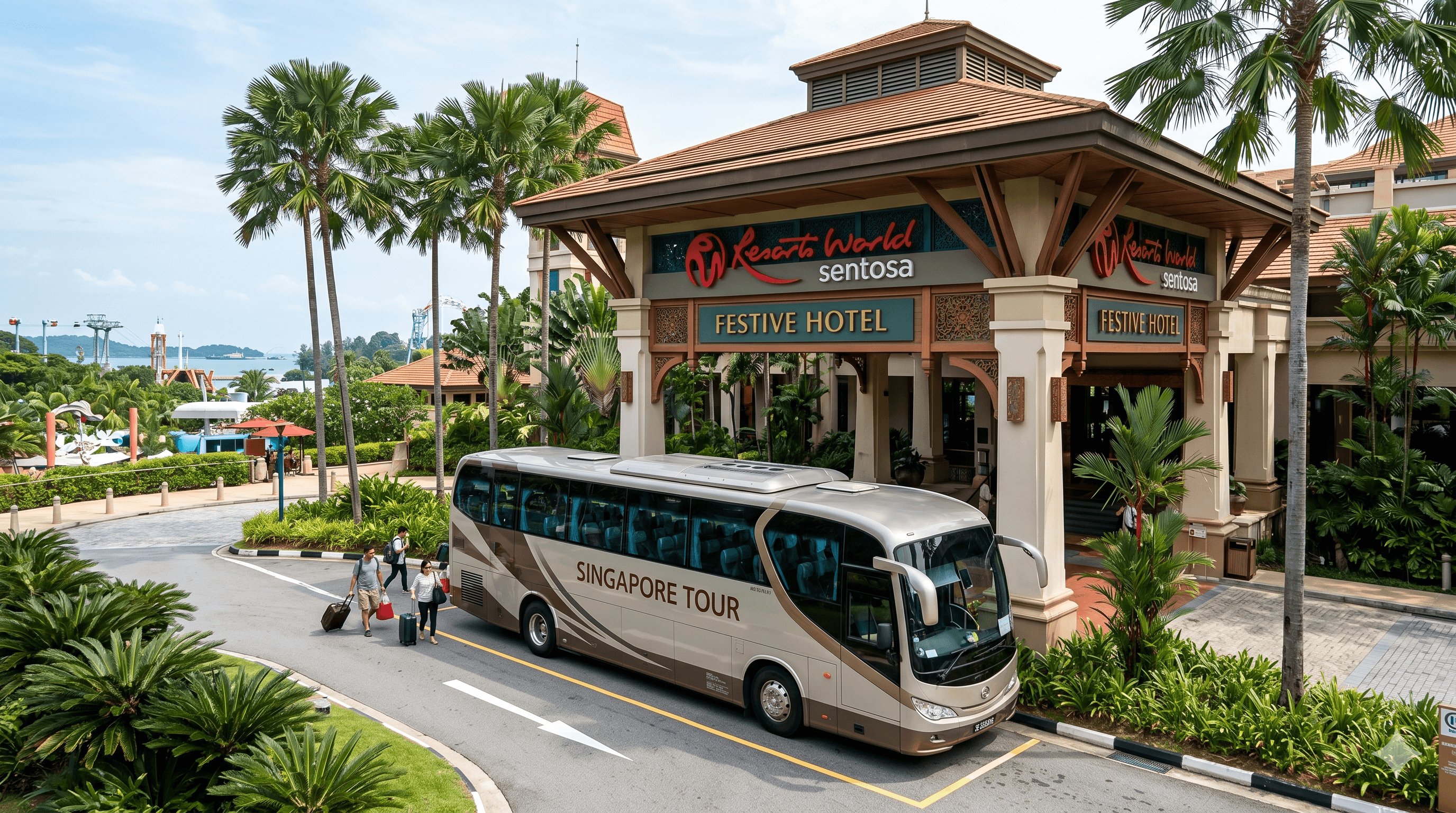
You've locked in the Sentosa venue. Lunch is sorted. The team building activities are confirmed. Two weeks before your 40-person company offsite, you suddenly realise: how does everyone actually get to Sentosa? One person suggests coordinating Grab rides. Another asks about parking. A third wonders if chartering a bus is overkill. Welcome to Sentosa team offsite transport Singapore: the logistical puzzle that often gets left until the last minute, but makes or breaks the day's experience.
Transport isn't glamorous. It doesn't get the same attention as the venue or the catering. Yet it sets the tone for everything that follows. A smooth, coordinated departure from the office is energising. People arrive together, settled and ready. A chaotic scramble for rides on the day creates stress before the day has even begun. This guide walks you through the planning stages: from headcount and vehicle selection to driver briefing, return logistics, and how far ahead to book. By the end, you will have a clear roadmap for moving your team to and from Sentosa: on time, together, and without unnecessary complexity.
Why Transport Is the Most Underestimated Part of a Sentosa Offsite
Most teams investing in an offsite focus their energy on two things: the venue and the programme. The venue sets the environment. The programme fills the day. Transport is treated as a detail to be sorted out later, often assumed to resolve itself through a combination of personal cars, taxis, and ride-hailing apps.
In practice, this assumption creates problems.
First, Sentosa's infrastructure doesn't accommodate large numbers of private vehicles. Parking at Sentosa resorts is limited and often reserved for hotel guests. A group of 40 people arriving in 15 individual cars doesn't just create parking friction. It fragments the team at the outset. Half the group arrives early, the rest late. The shared experience of the journey is lost.
Second, coordinating individual arrangements on the day costs time and attention. Someone inevitably forgets to book a ride. Someone else's driver gets lost. A third person cancels late and creates a no-show. The organiser ends up managing logistics when they should be managing the event.
Third, from a duty-of-care perspective, having everyone on a single chartered transport solution is cleaner. The driver knows the route, the destination, and the headcount. There is one accountable point of contact. Walking together into the venue as an intact team signals that the organisation valued everyone's time enough to plan it properly.
Headcount to Vehicle: Getting the Numbers Right
Board offers three bus sizes. The choice depends on your group size, but also on comfort and budget.
Mini Bus (up to 12 passengers). Compact option, good for smaller teams or satellite offices. Luggage counts as seats on this model, so a group of 10 plus four large bags effectively consumes all 12 seats. For a day offsite to Sentosa with minimal luggage, a mini bus suits groups of eight to twelve comfortably.
Medium Bus (up to 20 passengers). The sweet spot for most corporate offsites. A team of 15 to 20 fits with room to breathe. Luggage is less of a constraint here. Medium buses are common on the Singapore roads and manoeuvre smoothly through the Sentosa causeway approach.
Large Bus (up to 45 passengers). For larger offsites, annual company events, or situations where you're shuttling multiple departments. A large bus arriving at a Sentosa resort entrance makes a statement. It also allows for more flexible departure times if some attendees have conflicting schedules.
A practical note: many teams book one vehicle size up from their actual headcount. If your confirmed group is 18, booking a large bus (instead of a medium) buys comfort and flexibility. People get individual seats, the atmosphere is less cramped, and if a few last-minute additions come through, you're covered.
For context, luggage only becomes a real constraint on airport runs, where passengers typically have suitcases. On a day offsite to Sentosa, luggage is light. Assume business attire, perhaps a change of clothes if there's a swimming activity, maybe a laptop. This doesn't significantly eat into seating capacity on medium or large buses.
The Departure and Return Problem
Outbound transport to Sentosa is straightforward: everyone meets at an agreed time, usually the office, and departs together. The return journey is where most teams stumble.
People rarely leave at the same time. Some attendees need to head back to the office for meetings. Others want to stay for the afternoon activities or the evening dinner. A third group might have family commitments and want an earlier departure. If you don't plan for this, you end up with people waiting for the bus, or worse, some attendees missing the transport altogether and scrambling for alternatives at 6 p.m. on a Friday.
The most robust approach is to build return timing into your booking. Discuss with your team in advance: how many people are leaving at the end of the formal session (e.g., 5 p.m.) versus those staying through dinner (7:30 p.m. departure)? Then book two return trips, or book a bus on an hourly basis that stays on-site through the entire event. Board's Hourly service is designed exactly for this: a vehicle retained for the full day, available for departure whenever you need it.
If your group splits into two waves, coordinate the earlier return time with Board when booking. This way, the driver and vehicle are locked in for both legs. No last-minute scrambling, no "can we find another bus?"
What to Put in the Driver Brief
The devil is in the details. Your driver needs precise, written information.
Pickup: The exact address, building, and entry point. "Our office at Shenton Way" is vague. "Level 12, 50 Shenton Way, pick up in the car park, south entrance, 9 a.m." is clear. If you're doing a multi-point pickup (e.g., team members from two separate CBD towers), map the order: Raffles Place first, then Marina Bay, then Tanjong Pagar. Each stop should have a specific time window and a contact person on the ground.
Destination: Name the exact Sentosa venue. "Sentosa" is not enough. Is it Capella Singapore, Hard Rock Hotel, Resorts World Sentosa, or Palawan Beach? Each has different entrances, traffic patterns, and parking. A driver familiar with Singapore will know the difference, but you shouldn't assume. Write it down.
Intermediate stops: If the bus is making a detour (e.g., picking up clients from the airport before heading to Sentosa), list every stop in sequence with approximate timing.
Return schedule: Confirm the departure time from Sentosa, the route back (CBD office, residential areas, or a mix), and any intermediate drop-offs.
Contact information: Your mobile number, the driver's number, and a backup organiser's contact. Things go wrong. Someone on your team might get sick or miss the pickup. You need a way to communicate with the driver without delay.
Board provides a booking confirmation with all these details, but take ownership of writing it clearly upfront. A well-prepared brief prevents confusion on the day and shows professionalism to the driver.
Late Finishes, Drinks, and Getting Everyone Home Safely
A Sentosa offsite often involves a social component. Team lunch, outdoor activities, and then a dinner back at the resort with wine and conversation. By the time people are ready to head home, it's typically evening.
This is not the time to expect individuals to arrange their own transport home. From a duty-of-care perspective, the organisation has a responsibility to ensure everyone gets home safely, especially if alcohol has been involved. From a practical perspective, a booked return coach waiting to depart at 8 p.m. is far cleaner than 30 people requesting Grab rides simultaneously while slightly tipsy.
Board's Hourly service becomes valuable here. Book a bus for the full day, from office to Sentosa and back to the office (or designated home drops). The vehicle sits at the venue through the evening, available whenever the group decides to depart. There are no time pressures, no waiting for a second bus that hasn't arrived, no ambiguity. Everyone knows the coach will leave at the agreed time.
This also aligns with responsible event management. You're removing the friction and the temptation for people to drive home after drinks or to take poorly coordinated ride-hailing trips. A single bus with a sober driver is the considerate choice.
How Far Ahead to Book for Sentosa Offsites
Board recommends booking 72 hours in advance. For most transport requests, this timeline works. Buses are available, pricing is confirmed, and the booking is locked in.
For Sentosa offsites, extend this window.
Sentosa dates cluster. End-of-year team events run October through December. Mid-year strategy retreats occupy May through July. Public holiday eves see a spike in corporate bookings. During these windows, especially for weekends and public holidays, large and medium buses fill up quickly. Booking two to four weeks in advance is the prudent margin, particularly if your offsite involves multiple vehicles or a complex return schedule.
A confirmed booking means the vehicle is yours. The driver is assigned. The route is mapped. On the day itself, there are no surprises, no frantic calls to see if the bus is still available. That certainty is worth the planning effort.
For recurring annual offsites, booking early becomes a standing practice. Board's Corporate programme, with centralised billing and account management for high-volume bookings, is worth exploring.
Booking Your Sentosa Offsite Transport With Board
Board handles corporate transport to Sentosa and across Singapore. Book via board.sg. You'll input your group size, pickup point, destination, and date. The system will show available vehicles and pricing. Once you confirm, the booking is locked in.
For multi-vehicle coordination or specific requirements such as multiple CBD pickups or a staggered return schedule, email hello@board.sg before booking online. For companies with recurring transport needs, Board's Corporate programme offers centralised billing and tailored pricing. One contact, one invoice.
Related Articles
Latest Articles
- School Overseas Programme Transport Singapore: Changi Send-Offs Done Right
- Private Bus Hire Singapore: What It Is and How to Book
- National Day Transport Singapore: Planning Group Travel Around NDP
- Large Bus Hire Singapore: When You Need a 40-Seater Coach
- Gardens by the Bay Group Transport: Getting There Without the Chaos
Board Updates
No articles yet.