
18 Apr 2026
Corporate Transport Singapore: Why Scheduled Beats Grab for Executive Travel
The flight lands at Changi at 6.20 a.m. The VP of Sales has back-to-back client meetings starting at 9.00. She opens a ride-hailing app in the Arrivals hall and finds a twelve-minute wait, surge pricing, and a driver who — once accepted — cancels two minutes later. By the time she reaches the CBD, the morning has already started badly.
This is a familiar story. It is also an entirely avoidable one.
For organisations that move executives, clients, and senior staff regularly, corporate transport Singapore needs to be predictable. Not faster or cheaper — predictable. The vehicle should be confirmed before the traveller boards the plane. The driver should be at the kerb when the doors open. The invoice should land in accounts without a chase.
Scheduled chauffeured transport is built around these requirements. Ride-hailing is not.
What "Scheduled" Actually Means
Scheduled corporate transport means the booking is placed in advance — typically 72 hours or more before travel — and the vehicle, driver, and pricing are confirmed at that point. Nothing is allocated at the moment of demand.
For executive travel, this distinction matters more than it might seem. A scheduled booking means:
- The driver knows the itinerary before the day begins — terminal, flight number, meeting location, any intermediate stops.
- The vehicle assigned is the one quoted. A Premium Sedan or Luxury Sedan does not become a compact car because inventory was tight at 5 a.m.
- The price is locked. There are no surge variables between booking and travel.
- Someone at the organisation — an EA, a travel coordinator, or the traveller themselves — has a written confirmation they can reference.
Ride-hailing operates on real-time matching. It is well-suited to individual, impromptu travel in a city where demand is broadly predictable. It is less suited to executive-grade requirements, early-morning international arrivals, or any situation where a failed match has downstream consequences.
The Specific Problem with Ride-Hailing for Corporate Use
Most organisations using ride-hailing for business travel are doing so because it is familiar and frictionless to set up. The friction arrives later, in ways that are individually minor but cumulatively costly.
Surge pricing at the wrong moments. Demand spikes at Changi during early-morning international arrivals, at the CBD during peak hours, and across the island on public holidays and major event days. These are exactly the moments when executives need transport. Surge pricing at these times is not a bug — it is the model working as designed. For a personal trip it is a mild inconvenience. For a corporate travel programme, it is an unbudgeted variable on every high-stakes booking.
Driver acceptance and cancellations. Ride-hailing platforms cannot guarantee acceptance. A driver may decline a booking, accept and cancel, or simply not appear. For a traveller heading to a board meeting or catching a connection, the fallback — rebook, wait, repeat — is not acceptable.
Expense reconciliation. Individual ride-hailing receipts, submitted across a team, processed through expense systems, and matched to cost codes, represent a real administrative overhead. Corporate transport on centralised billing produces a single invoice, per period, per department. The difference in time spent is not trivial.
No named driver. Ride-hailing anonymises the driver until acceptance. A scheduled corporate booking names the driver, provides a contact number, and in the case of airport arrivals, includes a name board at the Arrivals gate. For clients or senior visitors being collected, this level of presentation matters.
What Corporate Transport Singapore Should Look Like in Practice
For organisations running executive travel at any volume, a well-designed corporate transport programme has a few non-negotiable characteristics.
Confirmation before departure. The traveller — or their EA — knows the vehicle details, driver name, and pickup arrangement before they leave the office or hotel. No app-opening at the kerb required.
Arrivals management at Changi. Inbound executives expect to be met. A driver holding a name sign at the Arrivals hall, tracking the flight in real time to adjust for early landings or delayed baggage, is the standard. Anything less requires the traveller to manage their own pickup while tired and carrying luggage.
Consistent vehicle grade. Executives travelling to client meetings or VIP events should arrive in a vehicle that reflects the nature of the trip. Board's executive fleet includes the Premium Sedan (Mercedes E-Class or equivalent, up to 4 passengers), the Premium MPV (Toyota Alphard or equivalent, up to 6 passengers), and the Luxury Sedan (Mercedes S-Class or equivalent, up to 4 passengers). The vehicle in the booking confirmation is the vehicle that arrives.
Multi-leg itineraries. A roadshow that touches four locations in a day — from Raffles Place to an Orchard Road client, out to a Jurong industrial park, and back to Changi for the evening departure — needs a vehicle and driver that stay with the itinerary. Hourly hire, with a four-hour minimum, covers this cleanly. The traveller is not rebooking between each leg.
One invoice. For finance teams, the value of centralised billing is straightforward. All trips across all travellers in an organisation, consolidated into a single periodic invoice aligned to cost codes. No individual receipts, no expense reimbursement cycle, no lost claims.
Choosing the Right Vehicle for Corporate Travel
The vehicle grade matters — not as a status signal, but because different executive travel contexts have different practical requirements. Matching the vehicle to the occasion prevents both over-spending and the kind of mismatch that creates a poor impression at the wrong moment.
Premium Sedan (Mercedes E-Class or equivalent, up to 4 passengers, 2 bags). The standard choice for single-executive airport runs, point-to-point CBD transfers, and client pickups from hotels along Orchard or Marina Bay. Professional presentation without ostentation. If the traveller is alone or with one colleague, this is the default.
Premium MPV (Toyota Alphard or equivalent, up to 6 passengers, 4 bags). The right vehicle when the group is three or more, when luggage is significant — returning from a week-long conference, say — or when the passenger mix includes a client and their entourage. The Alphard in particular carries executive associations in Singapore that a standard MPV does not, and the cabin space allows for a working conversation or a quiet debrief without anyone sitting knee-to-knee.
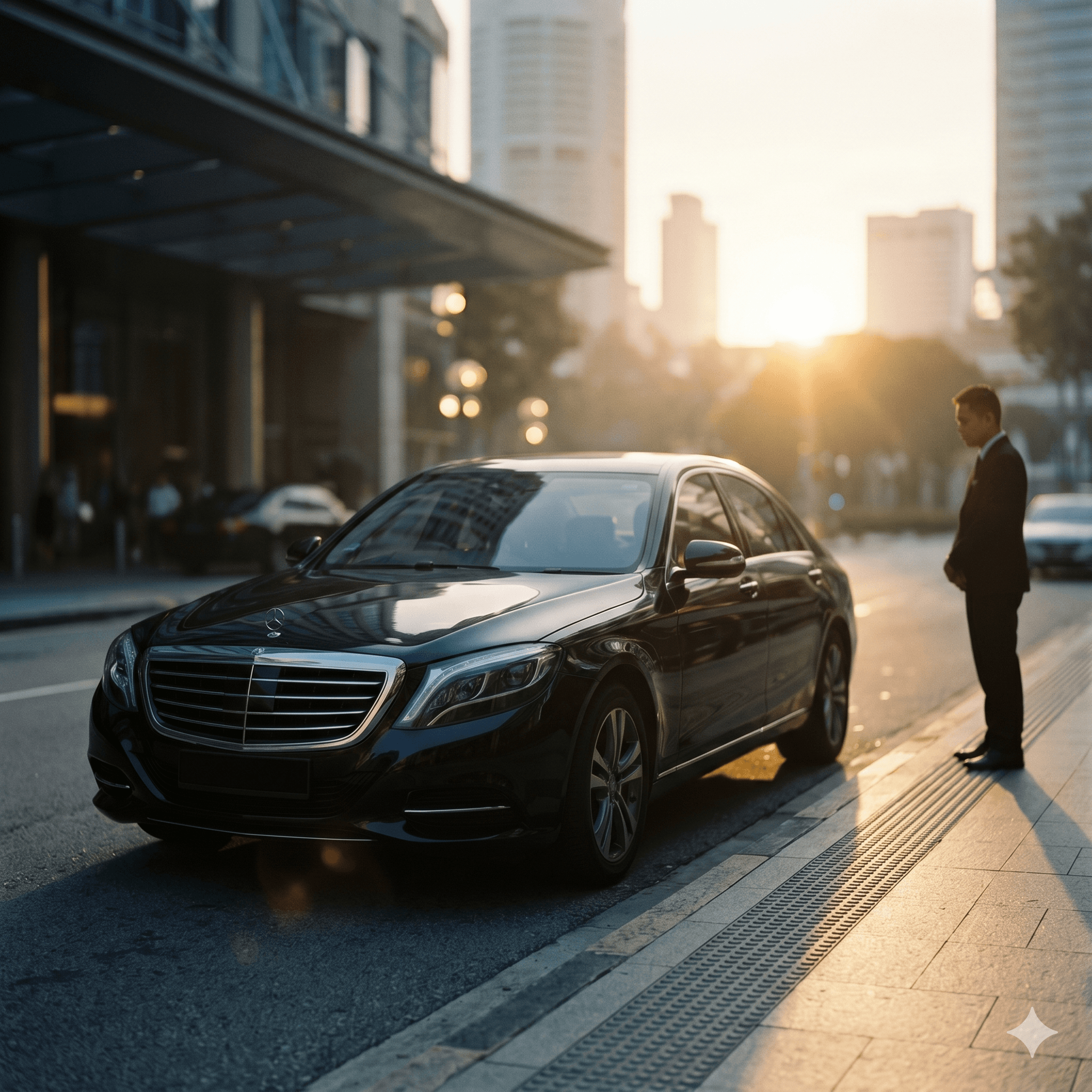
Luxury Sedan (Mercedes S-Class or equivalent, up to 4 passengers, 2 bags). Reserved for the occasions where vehicle grade is itself part of the message: a VIP client being collected from Changi, a leadership team transfer before a board presentation, or a senior executive who travels at a standard that reflects the organisation. The S-Class signals deliberate choice rather than default booking.
Organisations that standardise on one vehicle grade across all travel often find they are either over-spending on routine trips or undershooting on the moments that count. A brief vehicle policy — tier one for standard executive travel, tier two for client-facing or VIP scenarios — removes the decision from the individual booking and puts it where it belongs: in a considered organisational standard.
The Cost Framing That Changes the Conversation
When finance or procurement teams evaluate corporate transport Singapore options, the comparison is usually made on per-trip price. Scheduled chauffeured transport costs more per ride than ride-hailing on an uncongested route at a neutral hour.
That is the correct comparison in isolation. It is the wrong comparison for the full picture.
A more accurate framing includes: the cost of a missed meeting because a driver cancelled; the cost of surge pricing on a Monday morning Changi run; the cost of an EA spending forty minutes reconciling expense claims; and the reputational cost of a client being collected in a standard hatchback rather than a professional vehicle.
Organisations that have moved their executive travel onto scheduled corporate transport typically find that predictability, not cost, was the constraint they needed to solve. Once the vehicle and driver are locked in advance, a significant category of executive-travel risk simply disappears from the day.
How Board Handles Corporate Transport in Singapore
Board provides scheduled chauffeured corporate transport across Singapore for point-to-point transfers, airport runs, and hourly engagements. Bookings are placed through board.sg — the process takes a few minutes, and the confirmation is written and immediately available to the traveller and their EA.
For organisations with recurring corporate travel, Board's corporate programme offers a dedicated login portal, centralised billing, and tailored pricing for regular or high-volume accounts. There is no minimum volume threshold to enquire — the programme is designed for organisations that value consistent, professional service over ad-hoc convenience. Travel coordinators and EAs can manage bookings centrally, review upcoming trips, and ensure every confirmation is on file before the traveller departs.
To discuss corporate account options, contact the team at hello@board.sg. For individual executive bookings, the standard booking flow at board.sg handles everything.
Focus on the trip, not the booking. That is what corporate transport should feel like — for the traveller, the EA managing it, and the finance team reconciling it.
Related Articles
Latest Articles
- Hourly Car Hire Singapore: When Paying by the Hour Makes More Sense
- School Excursion Bus Singapore: How to Book and What to Tell Parents
- Sentosa Corporate Retreat Transport: A Planning Guide for Singapore Teams
- Luxury Car Hire Singapore: What to Expect From a Professional Transfer
- Airport Transfer Singapore: Grab, Taxi, or Scheduled for Groups?